
Reviewed · RIGA OLD TOWN TOURS
2 Hours Walking Tour in Legends and Secret of Riga’s Old Town
Riga keeps its best stories off the main road. This private walk links medieval churches, narrow lanes, guild halls, Soviet-era memories, and local legends in about two and a half hours. I especially like the small-group format, capped at six people, and the chance to sample Riga Black Balsam in a local shop. The main consideration is pace: with roughly 29 stops, some visits are brief looks from outside rather than full museum or church admissions.
Guide Lina gives this tour its strongest appeal. She uses old photographs and visual material to show how buildings changed through fires and war, and she adds practical restaurant and sightseeing advice. Wear good walking shoes, and treat this as an orientation tour first, with a few atmospheric surprises along the way.
In This Review
- Five reasons this Riga walk earns a place on your itinerary
- Why this private Old Town tour is useful on a first visit
- St. Peter’s Church and Town Hall Square reveal Riga’s medieval center
- Black Heads, Roland, and the city’s German merchant past
- Narrow lanes, Bremen musicians, and Dome Square
- Architecture takes the spotlight at the Stock Exchange and Three Brothers
- Powder Tower and Swedish Gate bring out Riga’s darker legends
- Freedom Monument and Cat House connect old Riga with modern Latvia
- The Baltic Way and Russian Theatre widen the story beyond medieval walls
- St. John’s Church, fortifications, and an underground surprise
- What Lina adds beyond the listed sights
- Who should book this Riga experience?
- Should you book the Legends and Secrets of Riga Old Town walk?
- FAQ
- How long does the Riga Old Town walking tour last?
- How much does the tour cost?
- Is this a private tour?
- Is pickup available?
- What language is the tour offered in?
- Is Riga Black Balsam included?
- Do you enter the churches and museums?
- What should you wear?
Five reasons this Riga walk earns a place on your itinerary
- Medieval stories with a local twist: Hear about golden roosters, execution bells, ghost stories, alchemy, and the number 666.
- A true private tour: Your group alone participates, with a maximum of six people for $108.43.
- Much more than the postcard sights: The route includes Rozena iela, old fortification walls, the Baltic Way marker, and a 13th-century underground space.
- Black Balsam tasting included: Sample Riga’s famous herbal drink and learn about its legendary apothecary origins.
- Excellent first-day orientation: The route covers the core of Vecriga and points you toward museums, restaurants, and places worth revisiting.
- Visual storytelling from Lina: Historic photographs help connect today’s buildings with fires, wartime damage, and earlier versions of the city.
Why this private Old Town tour is useful on a first visit
Riga’s Old Town is compact, but it can feel like a puzzle. A church tower appears at the end of one lane, a guildhall opens onto another square, and a plain-looking doorway may lead to a much older layer of the city. This walk gives you a map in your head before you start exploring on your own.
The price is $108.43 per group of up to six. That makes the cost about $18 per person if you fill the group, or about $54 per person for two people. For a private guide, that is a reasonable rate, especially if you have only a day in Riga or are visiting from a cruise ship.
You meet at the Grand Palace Hotel on Pils Street 12, with pickup offered and a stated pickup point near St. Peter’s Church at Reformacijas laukums. Since both locations appear in the meeting information, confirm the exact starting place when booking. The tour returns to the meeting point.
The route is offered in English and runs Monday through Sunday from 10 a.m. to 6 p.m. Most people can take part, but this is a walking tour over cobbled streets and old lanes. Comfortable shoes are not a minor suggestion here.
More Old Town tours:
- Riga Old Town walking tour
★ 4.5 · 304 reviews - Riga Old Town Walking Tour in a Small Group
★ 4.5 · 132 reviews - Private Riga Old Town Walking Tour
★ 5.0 · 62 reviews
St. Peter’s Church and Town Hall Square reveal Riga’s medieval center
The walk begins at St. Peter’s Church, observed from outside before you enter its free section. Lina explains the meaning of the golden rooster, both as a Christian symbol and as a practical marker for the city. She also connects the church’s story with the unsettling number 666 and the fate of the building.
This is a good early stop because it sets the tone. You are not only looking at Gothic architecture. You are hearing the beliefs, fears, and symbols that shaped medieval Riga.
At Town Hall Square, the city’s old commercial and civic life comes into focus. The square began as a market, then became the administrative heart of Riga. From here, you can look toward the Daugava River, the Latvian National Library, and the Museum of the Occupation of Latvia.
The square also brings in two memorable Riga stories. You learn about the Key to Riga and the city’s claim to the first decorated Christmas tree tradition. A memorial marks the 1510 Christmas tree story, giving a small plaque a surprisingly large role in the city’s identity.
Black Heads, Roland, and the city’s German merchant past
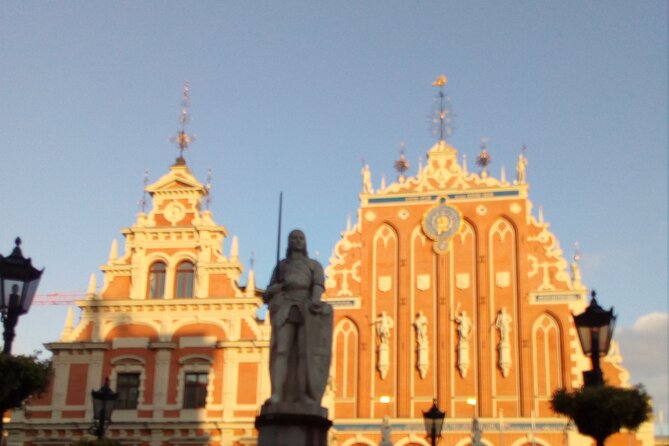
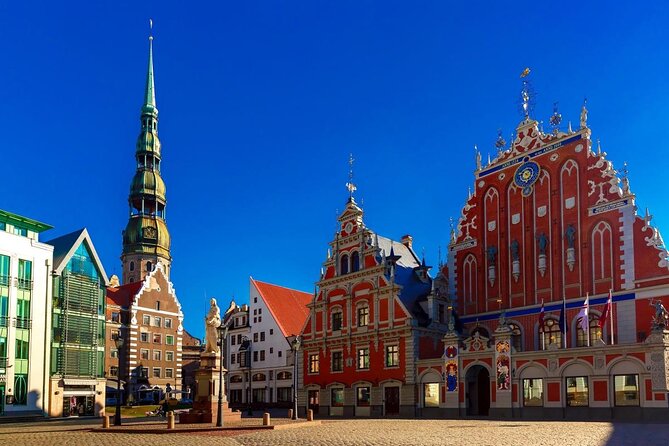
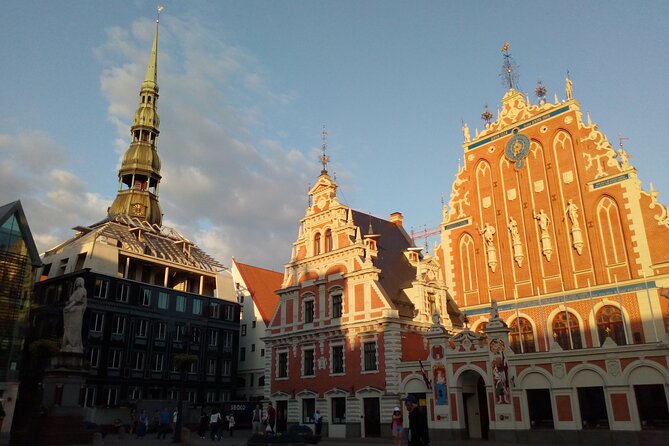
The House of the Black Heads is one of Riga’s most striking buildings. Lina explains its ornate facade, the clock, and the Brotherhood of the Black Heads, a group of unmarried merchants. The free portion includes a look underground and a discussion of the building’s alchemical and hermetic symbols.
The building’s decoration rewards close attention. Rather than simply taking a photograph and moving on, you get clues for reading the facade. That is one reason a guide helps here, since the symbolism is not obvious at street level.
In the center of Town Hall Square, the statue of Roland represents medieval civic freedom and Riga’s place in the Hanseatic world. Riga joined the Hanseatic League in 1283, and the statue’s shield and sword carry their own story.
You then pass through Jaunavu Street, an inner passage by Riga City Hall. A feature called River of Time marks Riga’s 800th anniversary in 2001. The route also points out a contemporary reference to Pharaoh Tutankhamun, an odd but entertaining contrast to the medieval setting.
Narrow lanes, Bremen musicians, and Dome Square
Rozena iela is one of the tour’s quick but memorable stops. It is Riga’s narrowest street, and you see a 13th-century city hall wine cellar from outside. Lina explains why lanes of this kind were linked with the drunk knight, a colorful reminder that Old Riga was not always solemn and polished.
The Bremen Town Musicians monument offers a lighter moment. Bremen gave the sculpture to Riga, its sister city, in 1990. The connection also reaches back to Bishop Albert, the Bremen-born founder associated with Riga’s beginnings. The monument is tied to a wish-making tradition, so you may want to make your own before moving on.
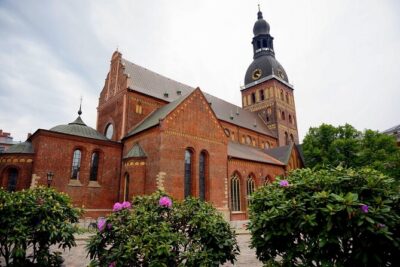
Dome Square is the largest square in Old Riga and the site of the main Christmas market. You view Riga Cathedral from outside and count its golden roosters. Lina also explains the square’s geometry and its symbolic design.
At Riga Cathedral, you enter the free section and hear about the church’s founding and construction. The pipe organ receives special attention. It was once the largest in the world in the 19th century and remains known for its sound. The rooster also served a practical role, since Riga merchants used it as a rough guide for planning their day.
The tour does not promise full admission to the churches. A portion of St. Peter’s and Riga Cathedral is included, but paid areas, towers, or complete church visits are not part of the stated experience. If you want interiors in depth, plan separate visits.
More walking tours:
- Best of Riga Walking Tour – Highlights and Hidden Gems
★ 5.0 · 147 reviews - Old Town Walking Tour of Riga
★ 4.5 · 28 reviews - Riga Art Nouveau walking tour
★ 4.0 · 27 reviews - Riga walking guided Sightseeing tour
★ 5.0 · 19 reviews
Architecture takes the spotlight at the Stock Exchange and Three Brothers
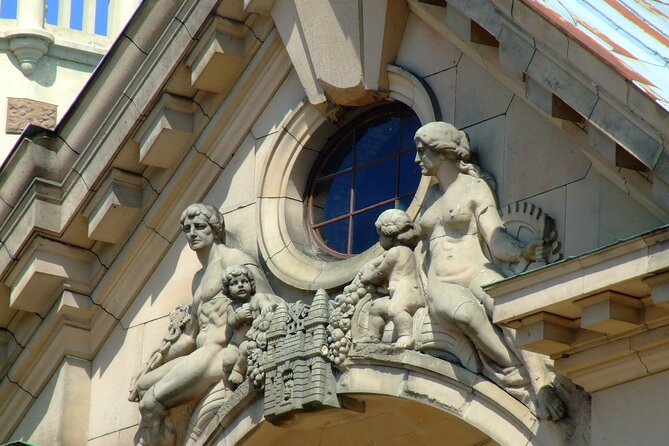
The Riga Stock Exchange Building offers a change of style. Lina discusses its Venetian Neo-Renaissance design and points out the only Venetian gondola in Riga. The building now houses a museum of foreign art, but the tour’s focus is the architecture and the gondola rather than a full museum visit.
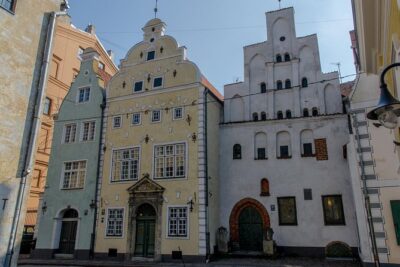
The Three Brothers are among the oldest surviving dwelling houses in Riga. Each reflects a different period of residential construction. You visit the oldest, dating to the 15th century, and see the free portion of the Latvian Museum of Architecture.
The inner yard contains Riga’s oldest coat of arms. Lina also explains the medieval window tax, a useful detail that turns an architectural feature into evidence of how city life was regulated. This is the sort of small story that helps you look at ordinary windows differently for the rest of your stay.
At St. Jacob’s Catholic Cathedral, you remain outside. The focus is the bell of the poor sinners, which rang as condemned criminals were taken from prison to Town Hall Square for execution. It is a grim story, but it shows how religious buildings, civic power, and public punishment once worked together.
Powder Tower and Swedish Gate bring out Riga’s darker legends
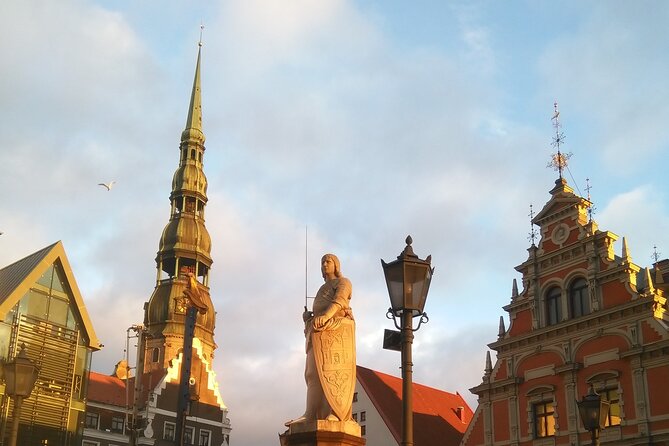
Powder Tower is the largest surviving tower from 14th-century Riga and now houses the Latvian War Museum. Admission to the tower and museum is free, so you can return later for a closer look if the subject interests you. During the walk, you observe the tower from outside.
Swedish Gate is the only remaining outer gate of Riga. It dates from the period of Swedish rule, which explains its name. Nearby, you see the house associated with the city executioner and hear the legend of the Riga ghost.
Jacob’s Barracks adds another layer. This long Old Town building once housed 5,000 Swedish soldiers. Today, its spaces contain souvenir shops, cafes, restaurants, and offices. It is an easy place to revisit after the tour if you want lunch or a small purchase.
The Black Magic Bar is one of the route’s most atmospheric stops. According to the local legend presented on the tour, the site was once a pharmacy where Riga Black Balsam was invented in the 18th century. You can sample the drink, along with learning about its alchemical symbolism and the secret door connected with the alchemist Kunze.
The tasting is included, but other drinks, sweets, and food are not specified as part of the price. Black Balsam is herbal, strong, and not to everyone’s taste. The sample is useful even if you do not want a full glass later, since it gives you a direct connection to one of Latvia’s best-known local products.
Freedom Monument and Cat House connect old Riga with modern Latvia
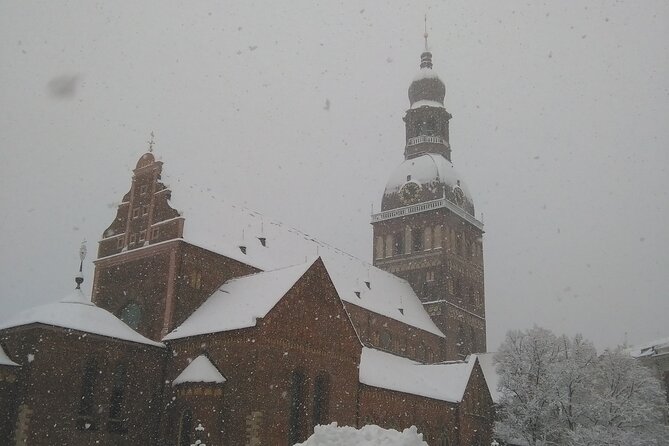
The Freedom Monument was built during Latvia’s first republic and remains the country’s main national monument. Lina explains its construction and hidden symbolism, along with why it matters so much to Latvian people.
The Laima Clock is a quick stop but an important city landmark. It is a major meeting point in Riga and takes its name from Laima, Latvia’s largest chocolate producer. If you spend time in Riga afterward, this clock is a handy reference point.
You pass through Ķēniņu iela, described as Riga’s shortest street, and hear how it became so short. At the Cat House, another familiar Riga symbol, Lina tells the story behind the black cat and its place in the city’s visual identity.
Livu Square brings more symbolism, including the Livs head monument. Nearby, the Small Guild recalls Riga’s craftsmen, while the Great Guild points to the city’s merchant class. The Great Guild, also called St. Mary’s Guild, existed from 1354 to 1936. Together, these stops explain how trade and skilled work shaped Riga’s public life.
The Baltic Way and Russian Theatre widen the story beyond medieval walls
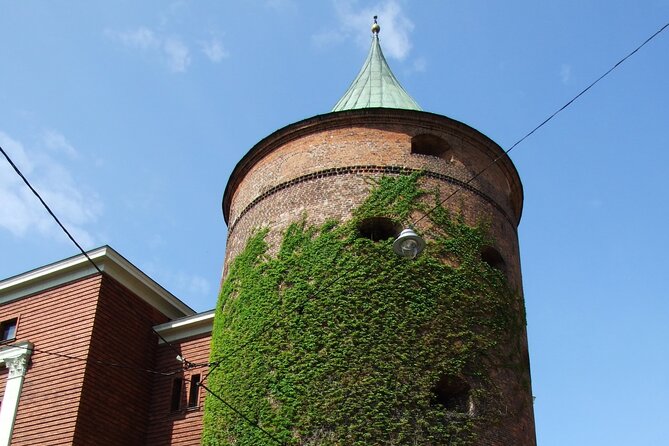
The Baltic Way footprint is a small red granite marker near the crossroads of Kaļķu and Vaļņu. It recalls August 23, 1989, when roughly two million Latvians, Estonians, and Lithuanians formed a human chain stretching 600 kilometers from Tallinn to Vilnius through Riga.
This is one of the most important modern-history moments on the route. The marker is easy to miss, but the event it represents was enormous. It took place while the Baltic states were under Soviet occupation and commemorated the 50th anniversary of the Molotov-Ribbentrop Pact.
The route also points out one of the oldest Russian theatres outside Russia, built in the second half of the 19th century under the Russian Empire. Its Florentine Neo-Renaissance design adds yet another architectural layer to the city.
You see the Riga Radio and TV Tower from the Old Town area as well. Built between 1979 and 1989 with Soviet central-government funding, it reaches 368.5 meters. This view gives the tour a useful modern contrast to the medieval walls and church towers.
St. John’s Church, fortifications, and an underground surprise
At St. John’s Church, Lina tells the disturbing story of two Dominican monks who were walled alive into the church. Their remains were found during 19th-century reconstruction, and the guide points out the location connected with the discovery.
You also see the oldest Riga gate leading toward the Dominican monastery. The stop is brief, but it is one of the tour’s strongest examples of how legends and documented history sit side by side in Old Riga.
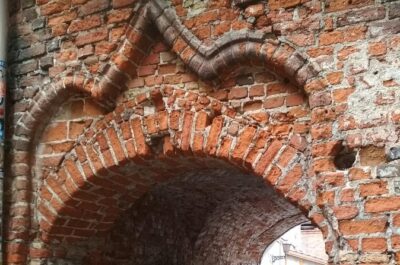
The Vecriga section includes a surviving piece of the 13th-century fortification wall. Germans built the wall during the era of the Livonian Order to protect Riga from invaders.
Kalēju iela, or Blacksmiths Street, is the Old Town’s longest street. It once followed the embankment of the Riga River, and its shape helps you imagine how water once ran through the city. The blacksmiths who worked here gave the street its name.
A particularly good feature, mentioned in the tour experience, is the chance to see an underground 13th-century space connected to an old building. The original walls and floors remain, and a tunnel links buildings on opposite sides of the street. The access point can be part of a restaurant setting, so conditions may vary, but this is exactly the kind of place you are unlikely to find by wandering without local help.
What Lina adds beyond the listed sights
The strongest part of this experience is Lina’s storytelling. She explains buildings, but she also brings visual material showing how Riga looked before fires, after wartime destruction, and following repairs. That makes the city’s damage and rebuilding easier to understand than a simple date-filled talk.
Her approach also suits families with adults and children. The stories include cats, ghosts, wish-making statues, secret doors, and strange church legends, while the historical material gives older visitors plenty to consider.
Lina also spends time answering questions and offering ideas for museums, restaurants, and additional sights. If you have only 24 hours in Riga, this advice can save time. One useful strategy is to take the tour early, note the places that interest you, then return to the Latvian War Museum, the museum in the Stock Exchange, or a recommended restaurant afterward.
The route is called a two-hour walking tour, but the stated duration is about two hours and 30 minutes. The many stops mean some are only one to five minutes long. You get broad coverage rather than long interior visits, and the pace is described as low-key and suitable for most participants.
Who should book this Riga experience?
I would choose this tour if you want a private introduction to Riga before exploring alone. It is especially useful for first-time visitors, couples, families, cruise passengers, and small groups who want one guide rather than a large crowd.
It also suits people who enjoy stories as much as architecture. The route covers famous buildings, but its real flavor comes from the odd details: a wine cellar, an execution bell, a ghost, a black cat, alchemical symbols, an old river hidden beneath a street, and a human chain that helped shape Baltic independence.
I would not choose it as your only cultural visit if you want extended time inside churches and museums. The route is wide-ranging, and many stops are viewed from outside. You should also expect a lot of walking on old streets and allow extra time if you stop for photographs or questions.
Free cancellation is available if you cancel at least 24 hours before the start time. Changes or cancellations inside that window are not accepted for a refund.
Should you book the Legends and Secrets of Riga Old Town walk?
Book it if you want to get your bearings fast and prefer local stories over a basic checklist of monuments. The private group limit, included Black Balsam tasting, visual historical material, and Lina’s practical advice make the $108.43 group price good value, especially with four to six people.
Skip it only if your priority is full admission to Riga’s major churches and museums. For everyone else, this is a smart first outing: broad enough to orient you, personal enough to answer questions, and packed with the small stories that make Old Riga memorable.
FAQ
How long does the Riga Old Town walking tour last?
The experience lasts approximately two hours and 30 minutes.
How much does the tour cost?
The listed price is $108.43 per private group of up to six people.
Is this a private tour?
Yes. Only your group participates, with a maximum group size of six.
Is pickup available?
Pickup is offered. The stated meeting information includes the Grand Palace Hotel at Pils Street 12 and a pickup point near St. Peter’s Church at Reformacijas laukums, so confirm the exact location when booking.
What language is the tour offered in?
The tour is offered in English.
Is Riga Black Balsam included?
Yes. An alcoholic beverage tasting of Riga Black Balsam is included at a souvenir shop.
Do you enter the churches and museums?
You enter the free portions of St. Peter’s Church and Riga Cathedral. Most other churches, museums, and buildings are viewed from outside, and full paid admission is not included.
What should you wear?
Wear comfortable walking shoes. The route covers many Old Town streets and includes a substantial amount of walking.
More 2-Hour Experiences
- Small Group Art Nouveau walking tour 2h
★ 4.5 · 6 reviews
Recently added around Riga
- Tour from Riga to Vilnius: Bauska Castle, Rundale Palace and The Hill of Crosses★ 5.0 · 3 reviews
- Group Tour: Sigulda and Turaida from Riga.★ 4.5 · 3 reviews
- Fun Walk Private Tour Around Central Market Riga★ 4.5 · 3 reviews
- Hiking Adventure in Gauja National Park – 7 Days★ 5.0 · 3 reviews
- Latvia’s Switzerland and Gauja National Park Tour★ 5.0 · 3 reviews
- Jurmala sunset tour★ 4.5 · 3 reviews
- Riga Medieval Dinner★ 4.0 · 4 reviews
- Private Snowmobile or ATV Safari with Riga Black Balsam Tasting★ 5.0 · 4 reviews
Riga Old Town Tours, compared.

Browse the lists this tour appears in